Front Load Washer
Not Draining
Click on the Steps below to jump directly to that section:
**NOTICE**
Wiring Colors, Connectors, and Pins will vary by model/product code. Always be sure to download and use the service manual for your specific model.
For Test Mode procedures use this link and input your specific model: https://lgtestmodes.com/
Verify in test mode that the unit is not draining and listen to determine if the drain pump is running.
Verify Drain Hose Installation and Check for Blockages
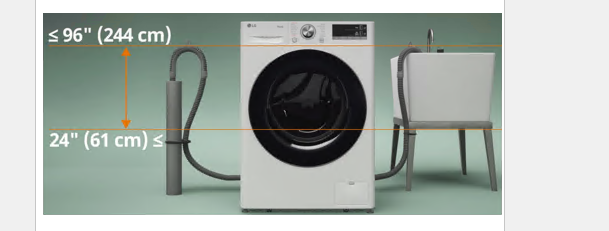
The drain hose should be inserted into the standoff pipe or a laundry sink. The standoff pipe should be between 96” (244 cm) and 24” (61 mm).
The drain hose entering the standoff, or sink, should have a bend at the end of the hose, (usually there will be an elbow bracket forming a bend), and no more than 4” into the standoff pipe.
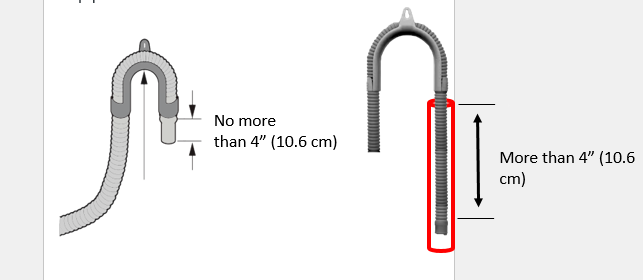
If the drain hose is too deep into the Stand off, more than 4”, it may siphon back and cause an IE error, or cause no, or slow drain issues.
Please check the install guide for your individual machine. These principles will apply to front loads, wash towers, and other select models.
Is the drain filter and pump housing clean?
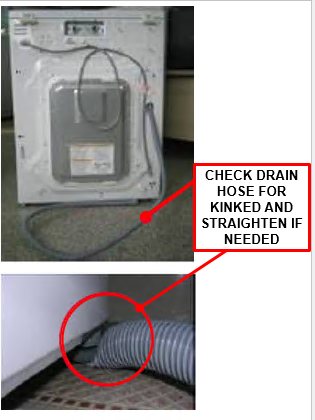
Is the drain hose kinked, twisted, or blocked with debris?
Has the drain hose been installed correctly? No more than 4 inches into the standpipe
Make sure that the drain hose is not stretched, pinched, crushed, or kinked.
Is there a laundry item stuck in the outer tub drain hole or bellows to the pump housing?
Is the air chamber or pressure sensor tube blocked?
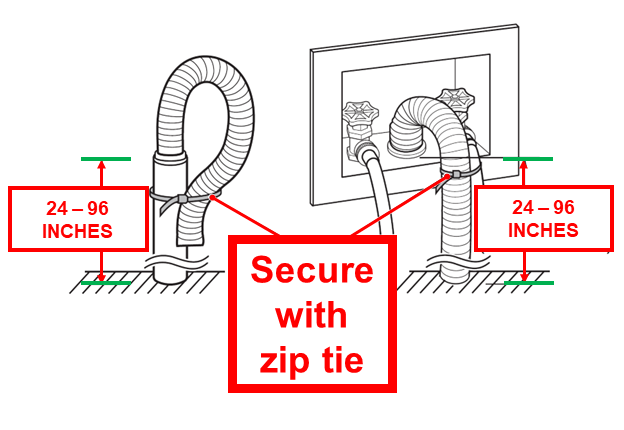
- The end of the drain hose should be located a minimum of 24″ and a maximum of 96″above the bottom of the washer.
- For best results, locate the end of the drain hose no higher than 66″ above the bottom of the washer. As the drain outlet is raised beyond 66″ the drain function will be increasingly affected.
- Never create an airtight seal between the hose and the drain with tape or other means. If no air gap is present, water can be siphoned out of the drum resulting in poor wash/rinse performance or clothing damage.
Check and clean the pump filter. Accumulation in the drain filter not only prevents proper drainage, but also will promote bacteria growth and cause odors.The drain filter should be cleaned once a month.
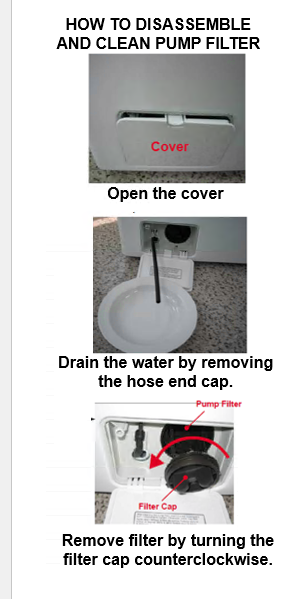
HOW TO DISASSEMBLE AND CLEAN PUMP FILTER. Open the cover. Drain the water by removing the hose end cap. Remove filter by turning the filter cap counterclockwise. Clean the filter. Re-install and close hose cap.

Check the Pump Resistance and Voltage.
Always make sure the wiring harness at the Drain Pump and at the Main PCB are connected properly.
LG uses two different drain pump types (Standard 120Vac 2-wire pump or a 26Vdc 3-wire pump). Make sure you identify your pump type and then use the information below to help troubleshoot…
120Vac Drain Pump Information:
Voltage Test: Place the unit into Test Mode and select the drain step so that you know voltage should be going to the drain pump. Check for 120Vac from the Main PCB and at the Drain Pump connector.
Ohm Test: Locate the drain pump on the wiring diagram for your model and test resistance across the 2 wires. Ohm reading should be 10-20 ohms.
26Vdc Drain Pump Information (BLDC Pump):
Note: LG started using BLDC style drain pumps in July 2018. If your unit was manufactured July 2018 and newer and has a 3-wire configuration it is a BLDC style pump. Use the below information to troubleshoot…
Voltage Test: Place the unit into Test Mode and select the drain step so that you know voltage should be going to the drain pump.
Special Note: The Drain Pump motor is a 26Vdc Brushless Motor using pulse width modulation dc voltage but can not be measured using a multi-meter set to DC voltage. You will have to use a multi-meter set to AC voltage to take this reading. The multi-meter needs to be a higher quality meter capable to read high frequency inverter pulses to get any meaningful voltage readings. The voltage you should read is around 11-12Vac.
Ohm Test: Locate the drain pump on the wiring diagram for your model and test resistance across the 3 wires. Ohm reading should be 1.5-4 ohms across all combinations of the 3 wires.
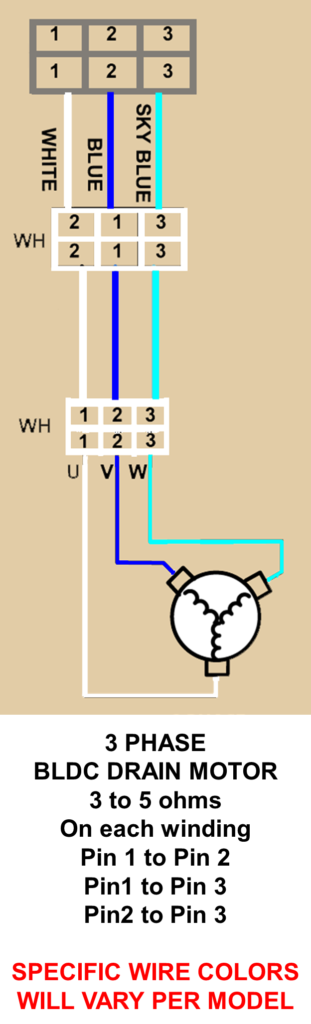
3 PHASE
BLDC DRAIN MOTOR
3 to 5 ohms
On each winding
Pin 1 to Pin 2
Pin1 to Pin 3
Pin2 to Pin 3
SPECIFIC WIRE COLORS WILL VARY PER MODEL

120Vac
DRAIN MOTOR
13 to 17 ohms
SPECIFIC WIRE COLORS WILL VARY PER MODEL
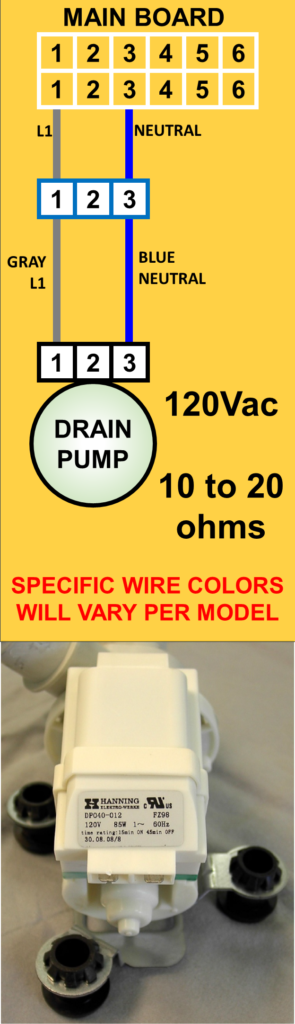
GRAY L1
BLUE NEUTRAL
120Vac
10 to 20 ohms
SPECIFIC WIRE COLORS WILL VARY PER MODEL